Summary Information
of Texts
The following is a general overview, chapter-by-chapter summary,
replete with the basic chapters themselves outlining the unique physical knowledge
and data in
241 Mumbers - the
Definitive Data for Fundamental Physics and Cosmology, as well
a short overview of its auxiliary text
Projective
Geometry and its Regional Subgeometries.
In essence, these books establish a categorically consistent and
complete finite system of `dimensionless' or 'numerically pure’
mumbers
or
‘membrane
numbers,'
the deepest tenets of geometry and the interfacing
['dimensional' or] metric principles of cosmological and particle physics. As
such, 241-Mumbers constitutes the only precise, predictive, and so unified,
Explanatory system that literally defines nearly every fundamental
parameter in particle and cosmological physics.
Originally, I naturally thought that, given the rapidly
expanding so-called information highway, such a revolutionary system would
be rather easy to generate more interest than my 1988 text on projective geometry. So, I figured I'd take my time with a few
preliminary promotions while I spent about five years developing A.J. Meyer's model that I
deciphered in terms of the dimensionless 'Monolithic system' while writing a
full length book, which we are about to summarize in a far briefer updated
format Which continually blew my mind as I made rapid progress making
countless discoveries until 2005, when I realized that virtually no one was
buying books any longer after a couple of national mailings. (I surely wasn't
alone as the Rant's page outlines, thanks to Amazon.com and attempts by
corporations like Microsoft and Google to digitize everything in major
academic libraries). So I indefinitely postponed that idea about 4/5ths of
the way through and still haven't finished the cosmology, so am strongly looking forward to exploring this subject
(especially after having recently
better refined some quantum mechanical issues supporting a long pondered
main hypothesis) after a fuller updated review of existing copy].) But I
figured the internet might be of value to at least promote the website, so I
spent the next few years refining it along with any necessary copy and writing a few articles backing up page 2's unprecedented proofs and
other more important data in e-magazines in order to drum up some interest.
But then I
was struck with jaded disgust by not only the lack of natural curiosity by those
who seem to be incapable of recognizing self-evident proofs, but the
almost complete cluelessness with respect to the importance of anything
like even the Strings 2000 questions per se, let alone their solutions, which then
seems that no one really expected could be answered! Indeed, it almost seems
that the majority of the physicists avoid confronting a new paradigm shift by
simply assuming such fundamental questions will indefinitely remain
unanswered and can only emerge in their publish or perish world of peer
recognized journal publications, so typically pursue whatever picayune
personal interests that may have captured their attention in a relatively minor
field of a too often half-thunk, half-bunk/half- junk, yet huge hunk of theoretical conjecturing.
Anyway, though I naturally initially expected more positive
feedback, I understood the predominant skepticism of egg-head scientists from
well before 2000. Indeed, once again even by 2003, I'd experimented with
enough initial promotions to suspect a large share of resistance. And so,
it's stated as much in the Preface with respect to Schopenhauer's 'Three Stages of Truth:'
- which starts with 1: being laughed at or Ridiculed, yet such heresy is too serious to take lightly, so then must be 2: violently Opposed
until the original truth becomes too obvious to deny and so only much
later is
3:
Accepted as
being Self-Evident! However, I'm nevertheless still continually
baffled by the fact I generally have no trouble personally explaining the major
discoveries, along with any number of deep nuances, to most laymen I know or
meet, especially now that I've refined my
ability to articulate a succinct Explanatory Story of Universal Creation from
11D Quantum Gravity (see * in section II.) and make sure it is fully communicated at an
interpersonal level in a manner that stimulates increased interest. Yet I then
find that having written, refined and published this new updated material on the
site over the last six months or so, I still get far more hits on old material
like polywell fusion, and possibly one read out of over a hundred or more of
just one of the five new essays summarizing this whole monumental system (and
that's after a recent web article on the solution to the hierarchy problem
concerning the Heavy and light Higgs, the former 'God particle' being still
quite topical!). So it hardly makes sense that after 15 years of being Ignored
at a 'Zero Stage of Truth,' that no more than a
literal handful of physicists have actually read and seemed to recognize any
such truths and proofs as being self-evident without some level of
indifference, suspicion or outright dismissal, however obvious it should
have been.
Yet on the other hand I at once feel somewhat sorry for
anybody who must realize that once the Monolith Solution is presented
in some higher educational forums and debated, at least then an
abreaction, whether it's ridiculed, opposed or otherwise disputed,
would be far more understandable. For dreams of getting some Comparable Personal
Meaning out of developing any similar Grand Theoretic pursuits (by anyone who at
least doesn't take some lame, senseless idea like the 'unbounded past and future
universe' of that over-rated knee jerk skeptic Steven Hawking as some sort of a role model), or the challenge of Empirically
measuring things like
quark
masses by a group think sink of approximate methods and models, that I've
already Proven on each of the first three pages here are grossly imprecise, seems
to be a nearly hopeless goal to achieve. Optimistically, of course, they'll
always be some need of both experiment and theory, and never a shortage of
important issues to address in any number of fields. But in regards to a really
fundamental subject like a Grand Unification of cosmology and particle physics
whose primary parameters are precisely expressed in equations that require no
additional artificial fine tuning, I'm sorry to inform you that that job has already largely
been taken and basically has been accomplished (not that I couldn't use some
enlightened help on any number of remaining levels!). Which is bound to make
some yet jaded established researchers, as well as many fledgling students,
feel like their role is approaching some sort of dead end, if just as a job
killer. Or at least it would seem to be a tougher filter for keeping one. Yet
even then, hopefully the majority of sensible folk might more positively regard
this preliminary message as a transformative paradigm shift unifying a
self-evident system of knowledge about the physical Universe, stimulating a
wider collective interest in learning and perhaps wider focus on teaching, both
academically, as well as increasing one's personal sense of their higher
Selves as Quantum Mechanical Beings. Which is to say that presently I'd simply
love to just find some amiable fellows who might already have a fair grasp
of any of all the fundamental issues, or any folks with a focused interest
in a creatively driven learning on any number of levels and/or fronts who
might appreciate the scope of an eye-opening and new worldview.
Anyway, although I originally hoped recognition would have
materialized earlier, after having spent a few years writing ezine articles
while casually refining some sloppy copy (up until about 2008, which stopped the
vast majority of us dead in our tracks, bogged down in the economic morass), which just intensified
confining my thwarted rage to Rants I love to cynically chant down with the darkest humor
till it gives enough release to move on to explore other personally dear
subjects. Like the more seriously important issues of comparing psychological
insights that heightens Gnostic consciousness with the constrictive
organizational structures that are collectively imposed from without, by
exposing the history of formal education, religion, covert operations, banking
and general polytricks within a global systems analysis that finally offered some synthetic solutions
with respect polywell fusion and other sources of virtually clean and free energy like Tesla discovered
years ago (which we are presently slowing building on a number of levels as a
home improvement project that's yet to be integrated there). All of which,
despite subsequently having since been waylaid for another 5 odd years by a
number of unavoidable personal responsibilities (at the end of our Rant page), I'm quite satisfied
enough with those results to realize that it would have been a little premature
to have expected that the book would have been a potentially as powerful as this
far more succinct updating, especially in light pf experimental challenges that
have only recently been offered.
Anyway, whatever the outcome might be, I've already been absolutely
honored that Providence, A.J. and the Strings 2000 Questions combined to give me the opportunity to learn directly from a
Source that turned
out to transcend my wildest dreams by light years. I've always have taken
great joy in an ongoing learning process at all levels, but never would have previously
anticipated the magnitude of such insights prior to the millennium. For despite the absence of collective validation, it certainly again allowed me blow my introverted little mind
many times over. So, upon far more gleefully returning to physics, I
now figure it would been rather premature to bore the reader with anything less
than the forthcoming succinct synopsis of the essentials. Which
nevertheless still allows me to rather leisurely indulge my fancies
amidst attending to any immediate chores (when I'm not dealing with and bitching
about all the mechanical breakdowns and typical BS that Murphy
periodically hands out to most of us), while generally meditating on various
ramifications, obligations, challenges, strategies and marvels of my wonderfully unique life and the gifts that have been bestowed. Which leaves a few solid days a week to focus on more serious study, writing
and refinements
on whatever specific themes are being developed. For I always figured that time would ultimately provide the proper
opportunity to diligently promote these discoveries. Which presently meant
better articulating the major issues in a succinct, optimally ordered and timely manner.
And it turned out that these long pondered plans seem to
have been timed surprisingly well, both with
respect to initially reviewing the essence of the model, studying and cleaning up a couple of dubious, incomplete
or otherwise complicated issues in light of newer data from the
particle data group site at
http://pdg.lbl.gov/pdg.html,
with a special eye on some novel insights with respect to both the 2012-15 data, particularly certain long anticipated predictions and
explanations for forthcoming results from the recently boosted energy at the
CERN collider. But before we put that cart before its horse, we should stress
that it is very important to appreciate that the forthcoming updated series of
short pdf and doc files should be read in the following optimized order of the
sections in which they are summarily introduced.
We begin with the
I: Introduction, which establishes
an exacting pure numeric invariance for a dimensionless physics tied to a
solution to
A.J. Meyer's 2-based logarithmic model representing a Cosmological Planck
Scale
associated with a derivation of one fundamental
Universal
"Monolith Number" Nu. Whereby we go on to more truly answer the #1
Strings 2000 question by transforming it to a far less rational natural
logarithmic system of A.J.'s original model utilizing a now purely derived
'fine structure number' associated with the inverse of a now discretely
quantized Electromagnetic
coupling constant. Whereby we go on
in the last
of these four pages, to utilize what I call the Meyer-Kaluza-Klein metric of the
combined A.J's proton + electron mass with its associated dimensionless
ratio to the Planck scale to further derive the effective Planck Mass as
well as the Gravitational coupling constant. Which effectively further
allows us summarize II:
11D Quantum Gravitational Universal Creation. But
before we can complete this Story, one must first understand the entire Supersymmetric Higgs mechanism
presented in our basic
III:
Particle Table1, allowing us to return to a short, but
more detailed, IV: Multiply Dual Quantum Super-Gravitational Mapping of Inflation. Which should be soon enough be cosmologically confirmed in a refined ongoing attempt to observe
primordial gravitational waves emanating from the far past 'Big Bang
event horizon' of a 'Hamed Membrane' effectively composed of
Heavy Higgs Bosons associated with
'White Hole' that Terminated the accelerated expansion of Inflation. This
true, so-called "God-Particle," therefore furthermore sets up an
overview of following era associated with the fuller V:
Supersymmetric Particle Spectrum and its Expected Major
Signatures from the Upgraded Large Hadron
Collider that was finally augmented and tested last year (in 2015).
241 Mumbers:
The Definitive Data for Fundamental Physics
Preface:
The history of A. J. Meyer's model, the Millennium
questions and the 'Monolithic' solution to Gross's quandary concerning a
"dimensionless physics" devoid of free-parameters. Some personal reflections on
religion, science and psychology are given with respect to a predictable
abreaction to pure numerical analysis; with hints from learning theory on
transcendence of self-limiting beliefs or assumptions. This lesson is augmented
by a couple of objective tasks, starting with an attempted derivation of one or
more pure equations for the value given in the first example in of our
Sample Data
and Proofs.
In light of our updated discussion on the homepage, the
Preface isn't essential and our second page here already has the original Sample
Data, so we'll forgo including these first two Chapters for now.
Introduction to the Tautology of 241 Mumbers via a
Co-Derivation of Global Coupling Constants:
After David Gross posed that #1 question at Strings
2000 concerning whether or not a purely numerical system of dimensionless
parameters in physics could be constructed, it motivated me to pursue an
affirmative answer. Whereby, after being sickened by a senseless three or four
month period of serial theoretical head-tripping, on 10-11-00 I came
to my senses by simply taking the
newest experimental value of the fine-structure number and, using
a reversed logic I'd used a few years earlier, I again just looked at
the 2-based fractional component, which was so close, it practically rounded
itself off to the inverse of a
discrete number. So, that's
how I deciphered A.J. Meyer's more rational 2-based logarithmic model, which at once
quantized the
non-rational natural logarithmic system of the fine-structure -
originally, by simply defining the 2-based "Monolith Number" Nu
= 203 + 1/241; just as it was introduced in the original paper of what
became a much lengthier Chapter 5 that also discussed all the Strings 2000
questions and rational for them. After I first met A.J. face-to-face at
that Coral Gables conference on gravitation and cosmology in mid-December, I prepared for the
task before me by looking anew at the Fermat mapping of pure numerical systems and their inverse
fractions. Which paid off in a number of respects, the primary one being it
allowed a set up of our dimensionless system of physics in our
consolidated
I:
3-Introduction.pdf.
by deriving
the
Monolith Nu
from a pure Fermat analysis that starts with subtracting
two 'fractionally inverted 241 numbers' from the integer 241 itself, followed by
dividing by 14, then multiplying by 12.
Converting the
rational 2-based Monolith Number to a non-rational natural exponential logarithmic
system and subtracting out the log equivalent to 2pi squared subsequently yields
the exact inverse of the electromagnetic fine-structure
constant expressed as a 'pure' number or, rather, mumber,
as discretely derived without any reference to 'metric dimensions' of mass,
length or time. Which solved that #1 question of
David Gross, which was chosen as the major quandary by him, Ed Witten
and Michael Duff (who supplied the third ranked question concerning the remote
possibility of proton decay, which I would have thrown out entirely by replacing
and Solving the better, and far more fundamental, question of why baryonic
proton (and leptonic electron) matter predominates over
anti-matter in the first place!) Which in any case, was a choice that blew
my mind that such esteemed company would ever even ponder such matters this
seriously, though A.J. and I had long wondered if such a solution to his model
was possible!
Now, another thing that always impressed both A.J. and I was that the Monolith
Number, whether it
is regarded with respect to his later 2-based, or earlier
natural, logarithmic system, basically translates as the identical huge
number 1.28925 x
1061
applicable to Dirac's marvelous 'Large Number Hypothesis'
with respect to a dimensionless mapping of an
effective cosmological Planck scaling.
Yet Gross's phrasing of his question seems to awkwardly limit the 'parameters' it speaks of
to merely dimensionless ones such as a ratio or scale, as if there was no natural way to synthetically tie any
such parameters to a metric
system employing mass, length or time, let alone something like a quantum
mechanical concept of a discrete particle mass. For
though as surely as particles can by duality be at once considered waves (just
as their behavior quantum mechanically can be regarded as being in
either an unmeasured 'evolving' state, or in a more specifically 'collapsed
state' as its 'wave function' is observed), a
particle that is tied to both a fully discrete dimensionless
system and one (combined) well-established measured metric mass is hardly comparable to either a wave or the uncertainty principle per
se! Which in effect also directly demonstrates why Gross's alternative of no
such possible dimensionless solution for defining a physical parameter due to
some sort of purely random "historical or quantum mechanical 'accident" seems
rather ludicrous.
For
A.J's journal paper (Meyer,
A. J. Physics Essays Vol. 8, #1, Dec. 1995, pp. 524-58)
that introduced the 2-based system showed that
the universal mass can be equivalently expressed as
2266.5
times the combined proton and electron mass mp+e.
Where, by subtracting out the Monolith Number, we consequently obtain the
dimensionless Ratio of the p+e mass to the Planck scale as Rplp+e
= 63.5 – 1/241. Since the 'quantum of least action' was defined by Max
Planck as what literally has become known as the "Planck constant" h,
or rather (since technically, we're dealing with Dirac's 'reduced' division by 2
pi) h-bar,
every metric term at the 'Planck scale' represents a
'quantization of gravity' so to speak. From the end of our
Introduction, it follows that the relationship of what might be unambiguously
best be called the neutrally charged 'Meyer-Kaluza-Klein system' of the combined
proton and electron Metric Mass
mp+e
to its Pure Mass-Ratio
Rplp+e
with respect to the Planck scale allows a categorically complete and
consistent co-derivation of the Planck mass and gravitational
coupling constant as well.
In
conclusion, the
Monolithic Tautology thereby represents a definitively discrete,
Quantized Unification of the Three Classical Fields and
their now non-ambiguously Derived Coupling Constants representing
a 'World-tensor' in an over-due update of a 5-Dimensional
Kaluza-Klein/Einstein-Bergmann Space-Time (sans six additional string
dimensions)!! '
An Initial State Synopsis
Explaining the
Quantum
Gravitational Creation of the Universe
in the Planck
Epoch: As promised on our updated Homepage
and Summary intro, the above
derivation of the 'effective' gravitational coupling constant and Planck mass in
the last section of our mere 4 page Introduction allows us to by-pass most
details outlined in Section II. of Chapter 6 (as later reiterated in the
first sections of our longest Summary Chapter 7 in the original [non-reedited]
text). Which directly addresses Ed Witten's #2 question (as well as
Einstein's original quote of the Homepage) about the quantum gravitational creation of the universe.
Anyway, here's the succinct Solution, as outlined in our second promised
essay II:
InitialtoFinalQGCreation.doc.
Which can be summarized and consolidated in the following manner.
For by first separately modifying and defining the dimensionless ratios of initial state and
effective Planck scales as respectively 63.5 and 63.5-1/241,
multiplying each these two ratios by the combined mass of the proton and
electron p+e gives two equations that therefore support a Definitive Explanation
that unambiguously Answers Dr. Witten's Question.* Our Story consequently Begins
by discussing how a Timeless
and compact 11D
Initial Solid State Primaton took a Quantum Gravitational
Jump to a slightly Larger, so Less Massive,
Spin Six Planck Boson that then began to Multiply and Tunnel
ever further Outward as it Rapidly Expanded into a brave New World that some
call Home. Which is to say that the Original Quantum Gravitational
Action henceforth Created both Time's Arrow and our Universe,
whose final Total Mass is given by Multiplying the Effective Plank
Mass by
2 to the Monolith Number!
We'll later go to more
explicitly outline the entire supersymmetric gravitational eras
of the
hyper-accelerated inflation, as well as in relation to the post
super-symmetric era, that can only be comprehended after assimilating the
essentials of our first particle of Table1. Which is to also say that both Short
(respectively 3 and 2 page) Stories have been recently written in common English for the
purpose of a very succinct and well articulated comprehension.
The Monolith Number is
further essential for precise derivations of
Table I: The Fundamental Particulate Scale, as augmented by a supersymmetric Higgs mechanism that generates mass, with a special theoretical eye on the
Origin of Baryon Matter, together with so-called
"Weakly Interacting Massive Particles,' or WIMPs, which essentially
consists of 'Dark Anti-Matter.’ So the first equations of this table determine the mass of, and relations between, the four
Higgs bosons and its two vacuum
expectation values, as well as the two
supersymmetric neutral Gauginos, the charged Wino, and the neutralino or 'Higgsino'- the latter being basically the 'left-over' component of the extended SUSY Higgs spectrum equivalent to a stable, heavy charge-neutral
'Fermi dark mass.' With further strong derivations of the respective
masses of charged W
and neutral Z Gauge Bosons that mediate the Weak Force, and each of the six
'flavors' in two 'families' of Quarks. For the hard mass values of the Higgs
fields, gauginos, gauge bosons and quarks are confirmed by the cohesive system
of equations as well as the
'pudding' proofs' of the Sample Data as was
initially witnessed in the Z-boson derivation where the masses of the quarks and
Higgs vacuum minimum purposely weren't even given, taken
together the down minus up quark mass parameter equal to the
differential between the charged and neutral pion, which allowed the reader to
derive the down mass given the differential from the up mass given on our homepage.
Which leads to calculations of a few essential hadrons, concluding with the set
'Bose dark mass' of the axion after preliminaries of neutrino sector
mixing that may be useful but is incomplete relative to detailed calculations
that require understanding complexities of the extended Table2 once
it is updated with a finer eye.
Likewise, a few calculations for certain
hadrons in Table1 were purposefully left a 'non-optimally precise values,'
though multiple approximations will often be used to illustrate or explore any
number issues for strong or less secure parameters alike in both the basic and
extended particle tables. But here the reader, with minor help, is left to
their own devices to spot which values may be purposefully left incomplete. This ambiguity is designed as a prod to provoke professors, students or interested
laymen alike to pursue additional hands-on home-study without direct reference to
the swamp of data in particle Table2. A few of these more important true values
will be given in the lengthy final discussion of the SuperSymmetric
Spectrum that summarizes the essence of Tab2 - though any really interested
party can, at least for now, simply ask me, ssheets@241mumbers.com,
what the equations are that give the best value for any of the mass parameters
that will generally be in the corresponding
cell of Table2. Belief me it'll be a lot easier to bug me for a bit or two of
enlightening data than it will be to update any shakier values in a detailed
re-edit of that 27 page table - frankly I think even deep thinkers will be
challenged enough to grasp the synthetic and integrated beauty of most of these calculations, given the relatively lesser density of the material in the basic 7
page outline. So, I'd love to facilitate an easier understanding of anything you
choose with mutual respect, well, at least as long as you don't prematurely
burden me with your own theoretical prejudices unless they happen to support my
conclusions or truly teach me something.
{Likewise, the first objective task given at the end of the Preface
and Sample Data refers to a parameter
and equations in one of the expanded table's most prominent cells, the Gluino: so is an ideal set-up
designed to discourage a peek before one can venture an answer without a
cheap cheat. [After one reads our basic particle table, we will however go on to not
only discuss more details of the inflation era, but it's general relation to the
gluino {beyond your chore of deriving some actual equations for its given
mass!}, squarks and the post inflationary Big
Bang proper.] Which then either A: serves as a test to bolster confidence in
one's intuitive perception and logical competence as an 'open
skeptic' and/or 'seriously interested learner;' or B: serves to test a 'closed skeptics' fixation on mechanical
measure and its associated uncertainties, collective or personal opinion, and/or hypothetical
'theoretical' interpretation; as manifested with utter focus on one's self-perceived role, problems,
given status or job in maintaining this system of peer friendly institutional
belief
by slowly adjusted, incremental refinements involving many researchers and
departments. Which isn't to say that either personality types couldn't come up
with at least one equation, though I'd bet in a heart beat that the latter
formal thinker would never bother to even try since that task isn't necessarily
related to any theory the fellow is familiar with. But the latter hub is only
weakly conducive to a broader 'paradigm shift' required for moving from a mere
intellectually intriguing 'Theory Of Everything' (TOE) that has yet to produce
to a concrete prediction of anything significant to a non-ambiguous
Explanation Of Everything replete with equations that produce precise
values for fundamental mass parameters that are often highly confirmable by easy contemporary
empirical reference.
Still, just as reference is an inevitable facet of scientific inquiry, taking the
easiest path is not only an endemic of part of human nature, but serves the better purposes
of scientific inquiry if it cuts through endless details and
formality to get a meaningful solution to the problems at hand - but certainly not
if used just a guise for an inability to investigate what isn't diligently sought
with open curiosity, honest interest and the meaningful intent of one's own
reasoning.)
Having explicitly seen how my deciphering of A.J.'s model the Introduction of
the Monolith Number led to a pure dimensionless expression of the
Fine-Structure Number, while the subsequent discussion of how the KK-Meyer
metric supports a Definitive Explanation for how a compact 11D
Initial Solid State Primaton took a Quantum Gravitational
Jump as it 'tunneled outward' to a slightly Larger, so Less Massive,
Spin Six Planck Boson that began to Multiply, Creating our
Massive Universe, thereby Answering the Top Two Questions of Strings 2000
(in a mere total of seven pages), let's now explore how the Monolith Number
generates a number of fundamental particle parameters as well! So, here is the promised essential data constituting our
III:
Basic
Particle 4-Table1.pdf
.
Mapping Inflation and SuperSymmetry with regard to the
Heavy Higgs-Hamed Membrane: Having seen that
the first particle that Sets Up our basic Particle Table1, and Sets its Value
at 6.4437 TeV as a function of its Dimensionless Scale Set By quartering the Monolith,
we are in position to confirm why, if one chooses to refer to a particle with Peter Higgs
last name associated with it as a 'God-Particle,' it must be the Heavy Higgs
scalar. For it's certainly not that lighter scalar of a mere 125.1023 GeV that the
LH Collider finally found, just because it earned him and Francois Englert
the Nobel Prize for confirming their predictions within the Standard Model - for
as the reader can affirm in the particle table that we Derive, rather than Set, that exact mass as a function of the
combined Upper and Minimal Higgs Vacuum Expectation Values. (Likewise, if anybody is
interested in pursuing this issue further, as a preface to the
second essay here outlining the extended particle Table2, it would be worthy to check out The 'God Particle' as the Heavy Higgs Boson and the Hierarchy
Problem Solution I wrote at Articlebase.com
-
http://www.articlesbase.com/science-articles/the-god-particle-as-the-heavy-higgs-boson-and-the-hierarchy-problem-solution-7368128.html.) Yet beyond
Setting that TeV
and dimensionless values, the basic particle table makes no more further reference to this particle nor its extended
meaning with regard to the Heavy Higgs identification with the Membrane
theory as it was originally construed by Nima Arkani-Hamed. For it was his ideas with respect to dividing
a universal dimensionless system by the respective integers 2, 3 and 4,
that led me to adopt the term 'Mumbers,'
which, as the opening poem on our Home-page suggests, is simply a short-hand for 'Membrane
Numbers,' though I naturally have increasingly come to interchangeably regard
the 'M' in Edward Witten's preferred generalization of 'M-Theory' as standing for
'Monolith Numbers.' In this regard, these forthcoming essays will
demonstrate just why the extended particle table2 will henceforth refer to the
God particle as the Heavy Higgs-Hamed boson and
likewise its 'Hamed scale' by the Plank ratio of NU/4.
Which now allows us to explore this terminology in a chain of summary synopses
of our newly updated series of papers extending our understanding of the power of the
Monolith Number with respect to mapping the full inflation era unto the later
supersymmetric era of a particle physics replete with an overview of predictions
and detailed explanations of forthcoming
signatures with respect to both cosmology and the recently boosted particle
physics at the LHC.
Mapping Creation and Inflation: The
first of these new essays, or fourth paper in our updated series, will make
little reference beyond the term Heavy Higgs to the particle tables as it was
originally attempted to be briefly summarized in a minimal two page paper called
a IVa:
Trebly Dual Mapping of Inflation with regard to the Heavy Higgs Hamed
Membrane.doc. However, upon reflection I soon realized that that paper
should have not only better reflected the
promised extension of the second paper 'Initial to Final QG Creation' with
respect to a more detailed explanation of the Quantum
Gravitational Creation of the Universe with regard to a
Completion of M-Theory as a distinct purely
11D Sixth String Theory
that explicitly marks the First Stage or SubEra with further
respect to a formal reformulation of what can most succinctly be called 'Quantum
SuperGravity' which inclusively addresses the fields that
drive and govern that First, as well as the Next Two Stages, covering the
Entire Inflation Era up to its Termination associated with the Hamed Scale.
Now in the process of formulating this extended manuscript, I discovered that
the founders of inflation theory had relatively recently admitted in a dialogue
of papers between 2013-14 that they were stumped by basically three factors, the
first of course being they had no idea beyond theoretical speculation of
what constituted initial state quantum gravity. So furthermore
they reached the conclusion of what they called their 'classical idea' of a single simple
'inflaton model' must instead involve
multiple stages of inflation, but in
effect again confirmed my long held suspicion that had little concrete clues
about what that entailed. Thus, instead of reading that incomplete above synopsis,
I urge you all to seriously study the first, only and 'Last Post-Modern Analysis
of Inflation' one will ever need to refer to! It covers a lot of ground and
as such is also an essential read necessary for a complete understanding of the next
two dissertations on V: supersymmetric particle physics and VI: cosmology as
well. All of which is told properly in a linear sense as One Story,
so we call this IVb:
The Quantum Gravitational Genesis of the Universe via a Multi-Dual Mapping of
Inflation with respect to the KK-GraviScalar and the Heavy Higgs-Hamed Scale.doc.
For a breif Summary of
this 14+1 page story begins with an overview of the short second paper in our
series with a more
detailed review of the 1: of the Initial State Planck/Motz
Primaton and its Minimal 0-Entropistic 5D Space,
as derived with respect to the First Set of Finite Axioms and subsequent plane
sectioning of it and the points intersecting the six-lines-at-a point of a
6D Manifold, as represented by the Pascal Conic the cover for
my definitive 300 page 1988 textbook that thereby serves as the
Basis for an 11D Projective Geometry.
Which at some point 2: takes a Quantum
Gravitational Jump to a slightly Lighter Mass and Less Compact Scale,
Creating Time by the UnWinding of the Six Dimensions of
SuperStrings as the Spin Six Plank Bosons Multiply
during the First de Sitter SubEra of Inflation. {Note: The
string unwindings of section 2, as represented by the untwisting of doubly-looped
'umbilical' strings into singly-looped rings that retwist and multiply into two sets of
umbili, as pictured in a separate clickable Diagram
I.doc.} This stage
subsequently culminates with the 3: Cessation of
String UnRavelings and Planck Mass Multiplications once 2 to
the Monolith Number of Pl-Masses is reached, equaling Our
Universe's Mass, as induced by a 'Unified Cosmological Field'
associated with a Massless Kaluza-Klein 55-Graviscalar
that is 'Dualistically' Identified with the Size of a Heavy Higgs Scalar
or 'Hamed Scale' NU/4
regarded as a 4D Space. As the suspension of string
un-windings marks the end of the initial inflationary subepoch, it must in turn
be identified with the beginning of a 4: Second or Intermediate
Stage of Inflation in which the Accelerated Expansion of the
Universal Hypersphere is Driven by the KK-GraviScalar or 'Radion'
regarded as an 'Inflaton Potential,'
which proceeds as the 4-Space is Dimensionally Reduced to a 3-Space
associated with what we call 'Nima's Scale' NU/3,
for which it is Proven that the Mass-Density of the
Universal Mass to the cube of its Size is Equivalent to a Single Planck Mass to
the cube of the effective Planck Length.
The Reduction of the 4-Space to Three Spatial Dimensions
5: subsequently Breaks Quantum
Gravitational SuperSymmetry, initiating the Third and Final
SubEra of Inflation by first Quartering Both the Plank Masses
and their Spin Six components, thereby producing the First Set of
('Primordial') Spin 3/2 Gravitinos. Gravitinos subsequently proceed to
Drive a Hyper-Accelerated Expansion due to their identity as
Fermions subject to the Pauli-Exclusion Principle, as Reinforced
by their Progressively
Lessoning Mass and Increasing Breadth that is
Quantum Mechanically Non-Locally 'Controlled' by
the 55-Graviscalar's role as a 'Coordinating
Mechanism' between Differing 'MemBrane' Scales.
Which is to say that whether the Gravitino Stage of
Inflation is considered to begin when the 'super'
quantum gravitational symmetry is broken at Nima's scale NU/3
or when four times as many fixed gravitino masses are generated by quartering
Planck mass, the 6:
Termination of Inflation is induced by the Transference of the Varying
Gravitinos' Mass to a Universal Mass composed of 25NU/4
Heavy Higgs Scalars of Fixed Mass, generating the Emission of Primordial
Gravitational Waves from the 7NU/12=7.18
meter 'Nima-Hamed' Radius of a 'White Hole' marking the BIG BANG by the
Emergence of Ordinary 4D Minkowski Space-Time and Relativistic Universal
Expansion! In preparation for the next two
papers respectively covering the SuperSymmetric Origin of
Baryogenesis and Dark Matter and Anti-de Sitter
Cosmology, this sixth section of our above dissertation actually
instead begins by returning to a discussion of the Radion as the
Quanta of Dark Energy that led Albert Einstein to contact Kaluza
with respect to his 55-Graviscalar regarded as Al's Cosmological
Constant. We do this in order to complete our earlier discussion
of the third and most pressing problem posed in a series of papers by notable
cosmologists with regard to what they characterize as 'classical' and 'modern'
Inflation Theory. For having clearly solved Ed Witten's #2 Strings 2000
quandary about the Quantum Gravitational Origin of the Universe, as well as
specifically outlining the each of the Three Stages of Inflation, we originally
address this third problem of a so-called 'Multiverse'
by most simply defining the Exact Mass of Our Universe that obviously
contains real massive particles other than dark energy. Which is to say that our
one and only, so final 'Post-Modern Model of Inflation'
goes on to demonstrate at the beginning of this sixth section that a
true 'Multiverse' that has the Same Mass As, but is
Not 'Our Universe,' can be described by a Radion Field which
Itself absorbs the Planck masses as soon as it kicks in as the accelerating
hypersphere reaches its full potential at the 4D Hamed Scale,
so then Immediately starts to Multiply as the Radions Lessen in Mass
in an Extended Period of (a nearly) 'Eternal de Sitter Inflation'
since the GraviScalar would have No Longer Reduced the Four Dimensional
Space to a Three Dimensional Planck Density, Bypassing any Additional
Gravitino Subepoch nor any Big Bang as the Radions would have continued to have
inflatively lost mass until they reached their quantized identity as a Minimal
Mass of Dark Energy defined by Dividing the Planck Mass by 2 to the Monolith
Number, whereby the Maximal Cosmic Constant is defined by the Squared Monolithic
Large Number of Discrete Radionic Quanta. After which the de
Sitter Space-Time would continue to accelerate and expand forever, until
perhaps some region of this Huge Space reaches a 'True Vacuum' that would
either Tear it Apart, and/or Further Minimize and Multiply Radion masses or
Evaporate it altogether! In any case I think the astute reader of this tidy
synopsis should easily appreciate the point that there are many reasons why the
Heavy Higgs boson should be considered as the 'God Particle,' the chief one being
that without the Hamed and Nima Hamed Scales there would not be Any Light and We
certainly would Never have Existed to see anything since the true post-inflative Bang Bang would Never
Have Occurred!
Mapping Particle SuperSymmetry as the Origin of BaryoGenesis:
We'll then naturally go on to summarize many of the main points from Table2 as
it was initially explained in the next section below, but now
will try to separate the second doc file referring to the Heavy Higgs with
respect to the post-inflationary era from the above fourth essay mapping
gravitationally induced inflation itself. So here is the next and final promised
re-titled synopsis V:
The SuperSymmetric Particle Spectrum with its Expected Major Signatures from the
Upgraded Large Hadron Collider. Given the previous revamp of the stages of
inflation up to its Termination with respect to the bulk emission of
primordial waves of gravitons by the Heavy Higgs bosons in the Big Bang, we go
on to discuss how the Heavy Higgs scalar first imparts
a fixed mass to Gluinos. Which themselves
then decay and
multiply into a succeeding series of flavored generations of, first three,
and finally nine, fractionally charged conserved Squarks, ofthis colored and anticolored plasma mixed with gobs of far more
stable and very light Axions (likely together with a few parts of their
heavier supersymmetric partners, the fermionic Axino and scalar Dilaton or
Saxion) representing a primordial condensate of Einstein-Bose Dark Matter.
with regard to the main
signature of Gaugino mediated supersymmetric mechanism responsible for Baryon
Co-Creation with 'WIMP' Fermi Dark Matter that should already be apparent from our
basic particle Table1 alone. So, as ever, Enjoy
Table II: The Extended SUSY and Standard Particle Spectrum:
The full table covering the entire swamp of mass-derivations and loose theoretical briefs
augmenting the above parameters. In addition to the Higgs fields and gauginos, the
'sparticles' includes the
ill-defined massive gravitino gluino, six flavors of squarks,
charged sleptons, their sneutrinos, a photino and axino/dilaton super-partners
of the axion. With essential details
of strong gluino and heavy squark decays to lighter ones that subsequently
undergo gaugino mediated transformations resulting in the creation of
baryon matter; along with the Fermi component of the heavier neutralino, in addition to
the Bose element of axion dark mass.
Much of which has already been discussed in both Table1 and the above summary of
inflation and supersymmetry with respect to the promised mapping of Heavy Higgs-Hamed
scalar as the true 'God-Particle." Which also offers the solution to the
'flavor hierarchy' or 'generation-inverted SUSY' problem, as well as clues to
super-symmetry breaking
as a prelude to electro-weak symmetry breaking, culminating in
a precise derivation of the Fermi
Energy of the Weak Coupling Constant. The format of
a descending mass-scaled data-table accordingly provides a succinct
forum for a working comprehension of the deepest theory (saving an expository
discussion for the Summary subsection), which conversely is
naturally encoded into equations that largely utilize ordinary arithmetic
to define each mass-parameter of the complete particle spectrum.
Likewise, each equation encapsulates revelations of
often multiple, and/or indisputable, physical principles, in addition to
the crucial precision of
numeric invariance that mirrors the Monolith Mumbers' fundamental 2-based exponential
tautology, which 'sets' the invariantly strongest, most immutable, or definitive parameters such as
the mass of the Heavy Higgs scalar. Which furthermore provides numerous mathematical, theoretical and empirical
cross-confirmations of not only the (already) definitive mass-values for all six
quarks, as well as equally definitive
supersymmetric precepts and values for sparticle masses such as squarks
and gauginos, by comparison with
derivations and values of a relatively well-established standard
particle spectrum
ranging from the Z and W gauge bosons
to over 50 hadrons. Thus, once an individual masters the basic tautology, system
and equations, they
can
confirm
the derived mass-values of weak gauge bosons or hadrons themselves by a similar empirical imperative for hands-on
learning2 - by comparison
with their measured values, most of which are given and downloadable from the
particle data group site at
http://pdg.lbl.gov/pdg.html (for the
sake of invariant consistency all basic parameters are in accord with the PDG and NIST
http://nist.gov/ measurements of 2000: so gather
these first from their archives). In any case, each parameter is evaluated by a
uniquely annotated, starred system of confidence that is pragmatic, instructive
and entertaining; serving as a central forum for a compact, often witty,
commentary.
(The wise will find the multiplicity of dark humor and pointed poetic asides are
not only core to a short-hand for rating arguments in a creative system of
learning, but also serves as a mnemonic prep for a higher theory that is not to be
ignored. Yet such word-play will also serve to make others walk right out the
first door: a main reason
Notable Rants is included as a
rudely blunt, 'purposely off-setting' X-rated sampling.0-1a)
Beginning with a determined value of the Upsilon-4s or B-B
resonance, calculations are given for various bottom flavored bosons
down to the neutral (bd-bar) and charged (u-) B-mesons; which gives extended
support for our 2nd
Sample Proof, b-mesons being
dominate products of Zo (or toponium) decay. Likewise, calculations
of
b-baryons range from a unique SuSy based prediction for the Omega-bss down to a
highly determined Lambda-b mass,
with hard theoretical deductions, calculations, and 'proofs'
for
intervening values of
both charge and spin mass states of the b-Sigma's,
as well as yet unmeasured masses for the -charged and neutral Xi-b. Table II moves to charmed
hadrons, beginning with unprecedented predictions for the ccc-Omega and three cc-Xi's;
with calculations that similarly serve as demonstrative proofs based on interrelations between the SUSY sCharm/sTop differential, quark derivations conforming to other higher states of
charmed flavors of positive charge and spin and logical comparison of decays of the
W++-ccc
into a
ucc-X++,
or of the spin 3/2
ucc-X++ into
a dcc-X+
and a +pion. (Which all in all accounts for a set of quite nuanced
proofs, though these value presently are largely unavailable as empirical
measures of pudding in the sense that the '04-6 pdg-listings only
gives the ccd mass; as editors at lbl
were apparently baffled by rather convincing SELEX
data for the two ccu-Xi spin states. So though our comparative calculations fit
cc-Xi data too well not to recognize there's piles
of pudding on the table - the initial reaction to the
data in the general physics community was absolute surprise, owing to a novel large gap between the cc-Xi's
containing the up quark and the one with down; which misses some major points).
Anyway, we go on to derive masses of the J/psi and eta cc-mesons
before moving to singly charmed c-baryons, with charmed Omega,
Xi's and Sigma's of
both J= 3/2 and 1/2 spins, the double-charged cuu-Sigmas constituting a third
state of slightly higher mass (due to more repulsive q-charge) than the neutral cdd
in both cases. These heavier c-baryons are scaled with respect to differentials
to the base state c-Lambda+
- whose mass is determined by a calculation from a Wino and/or its decay - which
contrasts with the following equations to provide the most nuanced set of
demonstrative proofs and broad supersymmetric correspondence in this table. The case in point involves
strikingly
instructive derivations of
the charming D+ cs
and cd mesons utilizing
appropriate SUSY modifications of a similar equation as a function, and main
decay product, of a (by convention, positively charged) W-boson (and goes on to define the tau
lepton mass by an equally
revealing modification). Two auxiliary calculations not only give a precise
correspondence for the cd-D+ mass within an order of about 1/10,000,000 parts,
the most important being a direct derivation from the given c and d quarks that serves as a
proof for the neutral D as well - the real pudding here being the multiple
calculations and correspondences, the multiple accurate correlation with measure being
here only a
little cherry on top, marinated by the chef in a sherry wine2b. In
any case, the hadron table next moves on to
strange
baryons, all calculations, except for the
sud-Lambda per se, being determined by a different route that the differential
of charmed Omega, Xi's and Sigma's to a
c-Lambda
- as multiples of the strange mass, with appropriate modifications involving combinations of the down and up. We
then go on to give the derivation of the time parameter for beta-decay of a free
neutron to a proton, electron and an antineutrino, completing the equation given as the
4th example of Sample Data. Which serves as a
perfect introduction to a precise derivation of neutron mass as a ratio to our
basic p+e-gauge. Having exhausted baryons, we
finalize analysis with a review of the strange K and pi mesons
developed in the first table. We proceed to list the
various combinations of first generation quarks composing the basic light baryons
and mesons, the same mass differential in each class of hadron constituting our 3rd,
and Best Proof in theory, application or pudding.
This hadron schematic is
supported by equally precise, and revealing, electroweak derivations for the tau
lepton and muon, that together with the measured mass of an electron produced in
W-mediated weak beta-decay, compose the three types of charged lepton that
may be created, along with a respective flavor of neutrino, in a direct
decay of a ('non-virtual') W-boson. The attendant scaling in sum provides clues to the
time-decay parameters for the tau or muon into neutrinos, which, in addition to
the given t-parameter for neutron decay
into a proton, electron and e-antineutrino, supplies an
exacting framework for analysis of neutrinos as having a definitive weak mass at
the moment of creation. Yet thereafter they can oscillate to another mass-value by
virtue of 'flavor mixing' - where, for instance, we give a precise calculation
for the 'e-mu mixing angle'
that accords with its experimental value,
further also accounting for the suppressed 1/3 ratio of electron neutrinos to
theoretical estimates of massless ones. Which must then also
determine the `base-value' of the electron {or
analogously, a tau or mu} neutrino
mass,
as a function of its very definition as a fermion conforming to the
monolithic tautology of mumbers, as specifically compared to a relatively stable dark mass
that defines an axion as a boson - with respect to a common scale representing
what can be called a ''charge-neutered,'
symmetry."
Mumbers and the Monolith Numbers: I:
The broader, more philosophical underpinnings of our
Introduction's Tautology
discusses the significance of the Monolith Number
to not
only a dimensionless physics, but a
number of other pertinent Strings 2000 `Millennium Questions’ as well.
The
Unified Universal Meta-Physics of Monolith
Mumbers: from Socrates to Oskar & Felix Klein,
and Beyond
begins with a few reflections on the
unfinished business of synthetic dialectical discourse from the Socratic school
unto the 'formal simplicity' F. Klein perceived could serve as a final basis for
Einstein's extension of the (O.) Klein-Kaluza unification. We then briefly
demonstrate how debates in religion, science and politics can consistently be
linguistically resolved within a synthetic and 'holistic' natural philosophy,
beginning with a firm geometric, numeric and meta-logical basis for a 'Wholistically' Unified Physical Theory. Which
leads to a discussion of the significance of such issues to the development of a dimensionless monolithic meta-physics, a finite, sentential Hilbert algebra and multiple
(Godelian) meta-mathematical (numeric-geometrical-logical) 'mappings' for an 11-dimensional physical membrane
(see article for the geometry text below).
II: Initial-State Quantum Gravitation:
minimal entropy and the significance of an initial-state, antisingular
Planck-Motz 'primaton' to Creation.
With exacting equations and illustrations that demonstrate how an initial-state
anti-singularity/wormhole theorem gives rise through quantum gravitation to
an internal 6-dimensional
manifold of superstring spin-replications that evolve unto a classical de Sitter Era of
Cosmic Creation. III:
Which leads back to a discourse on the basic meaning of
The Monolith Number as a
'Multi-Dual' Cosmic Constant, primordially
represented by Meyer's precise derivation of the `conserved,' or so-called
'critical,' Universal Mass! Which fulfills the role Dirac envisioned when he
postulated his famous Large Number Hypothesis. But the text goes on to stress
the more common history and other introductory comments about this constant
before concluding with an overview of the
evolutionary substages of de Sitter Inflation mapped with respect to a
`dimensional reduction' and `projective sectioning' framed with respect to an
increasing scale of the monolithic space-time membrane.
Summary Flow of Cosmological Eras, Parameters and Geometries: A
~70 page review and extended description of the spatial stages, temporal eras and parameters
defining universal creation, inflation, the post-inflationary era and
latter cosmic evolution extending from the big bang to our present era, unto the
end of time. Twenty more pages are devoted to the Extended Era of de Sitter
Inflation, as co-driven by supergravity - with radii,
mass-densities and superluminal velocities at various stages up to its
termination. Which is followed by an extended discussion of Table II's deductions
concerning
the
Super-Symmetry
Era and the Origin of Baryon Matter and Dark Mass. Beginning with a few speculations about a dual role
of supergravity in the pre and post inflation eras, we review the resultant theory
(that serves as a prelude to this subsection's conclusions), with additional specifics of sparticle decays outlined in the extended table. A detailed explanation of strong gluino and first generation squark
decay follows: resulting in a multiplication of 2nd and 3rd
generation
squarks, as accompanied by a progressive co-production of a gluon (or massive 'glue-ball like') plasma
and a relatively co-stabilized or mass-conserving axion field [that furthers a concise derivation of the parameter
representing the coupling constant associated with axion decay into photons in
the presence of a strong magnetic field]. The discussion then proceeds unto the
latter stages of the SuSy era representing gaugino mediated conversion of
these lighter squarks - resulting in baryogenesis, with an accordant explanation
for the origin of neutralino dark mass as well. Though this solution for the
origin of baryon matter is a revolutionary affront to certain
common assumptions, it at once accommodates and accounts for standard theory or
interpretation - for example, it allows the exact determination of the two `CP-violating' decay modes
of the neutral K-meson into pions, which provokes some remarks about similar reasoning
involved in determining our final value for the Ko mass per se. This
subsection concludes (as it began) with a comparison of the hypervelocity at the
terminal inflation radius to a necessary highly conserved mass, so maximal gravitational field, during and up
to super-symmetry breaking
- that specifies its
space-time parameterization
as well. Which proceeds to compare the mechanisms of, and review the
mass-energies at which, the respective Super and Electro-Weak Symmetries are Broken,
concluding with a discussion of glue-ball decay as mesons, where Table II lacks
the specifics of these hadrons. Which very naturally leads to a shorter subsection giving precise
Critical Mass
Percentages of baryon
matter, neutralino antimatter (oops!), as well as axion
dark mass. Which can interpreted in three manners: as a percentage of Planck
mass, a percentage relative to the 'critical
universal mass' gauged in terms the particle in question, or (the {only} way to determine the mass-percentage of neutralinos) as
ratios to a single gluino (since once they begin to decay, quantum principle
limits what anyone can say). In any case, the remainder of 'critical mass'
represents 'quintessence ' or 'dark energy,' whose discrete mass-energy
is specifically co-defined by the cosmic Monolith under an inverted duality.
In the next subsection, the
minimum mass and horizon radius of a stellar blackhole are explored -
essentially determining the Minimal Blackhole Horizon Radius. Which is not just
framed in usual terms of a Schwarzschild horizon relative to our sun's solar
mass, but more particularly with respect to
approximations tied to squaring or 'doubling' of our fundamental dimensionless material
(or p+e) scale, as well as some other
special mumbers. Moving further up 'mumber scale,' the next subsection analyzes the fine-structure number taken as a two-based exponent.
Which serves to define a "Truly 'Anthropic' Physical Principle" that proves to be the bio-physical frequency of human awareness and thought! This scale is also tied to electromagnetic parameters associated with the physical dimensions of
"Gaia," taken as the literal atmosphere of old 'Mother Earth.' Or
equally, but more figuratively, 'she' can be seen as the, or as an, `earth
mother' {she's old, fat and pretty near burned out: i.e. the perfect
goddess-mirror for hippy feminists, or me!} As a 'public service,' we show how
the calculation further supports a relevant example of confirmed
and applied
accumulated knowledge that runs counterintuitive to what some well-meaning
scientists or other guru wannabe's hawk as popular wisdom when referring to
benefits that follow from a general technique of 'passive meditation.'5
The subsequent section, takes the
fine-structure number for the exponent in a natural logarithmic base,
as utilized in A. J. Meyer's original tautology: which serves as a
basis or 'gauge' for a 'fixed cosmic
age' (~550 million light years). Which provides a link to, or interlink
between, various parameters via a common scale identifiable with time6 -
here essentially describing the Post Big Bang Eras
of Radiation Decoupling, Anisotropic Re-ionization, and Early Stellar &
Proto-Galactic Formation, relative to a Basis of a Fixed Cosmic Age. After
a brief review of the post big-bang `radiation era,' the 'age-gauge' facilitates mapping its `decoupling' from emergent neutral hydrogen matter at around a third of a million years, which today has been dispersed and red-shifted to the chilling temperature of the cosmic microwave
background (CMB) field.
This schematic hence invites comparison with parameters provided by the 2003 results of the first year of data for the WMAP probe (its website http://map.gsfc.nasa.gov/m_mm.html serving as
info-central for most related astrophysical projects) mapping
anisotropies in the CMB at decoupling; which provides inferences about the
distribution and evolution of energy, matter and space-time operations at various stages of cosmic development. Further
calculations are shown to coincide with the peaks and troughs of the
WMAP's 'thermal angular power spectra'; but adds little beyond
supporting a broad view of an `era of re-ionization' across a swath of stages from the earliest stars unto their initial
or proto-galactic evolution. But firmer or at least more intriguing are the
underlying acoustic parameters at decoupling, which originally were released
as a mechanical energy
by gravitationally induced perturbations that produced literal Big-Banging
'waves of sound'.
Which
seems to
in some sense offer a peak into the future of the universe7 that
serves as the perfect lead into the final
subsection, as summarized below, and consolidated into
one diagram, that erases certain `apparent paradoxes of present measure' by
proposing a Multi-Dual Cosmic Constant for a
Closed Regenerate Space-Time.' For all diagrams follow from our first;
all fluctuations constrained within a 'primaton horizon' until the quantum gravitational jump from a minimal entropy to a
lighter, larger, Planck state at Creation. Which set supersymmetric
transformations and replications of the internal 6D super-string manifold into
motion as its hypersphere bursts through the 'Planck Event Horizon' unto a
classical de Sitter era of vacuum mass creation and space-time signature
SO(4,1). Likewise, the entire 'Inflation Era' represents
'a
de Sitter Period' of
an exponentially accelerated spatial expansion'. Yet the notion of a `modern
cosmic constant' lacks such creative and inflative de Sitteresque qualities;
so comparatively appears better adapted to an explanation of a
'repulsive quintessence' fueling the present accelerative' phase, which effectively kicked in
'after decelerating in eternal expansion.'8 Half of our final diagram
includes mappings of such infinite space-time metrics with respect to what synthetic
geometry calls the `Absolute' - which the whole diagram takes special care to conformally map
in a like manner as the actual geometry, topology, and numeric tautology of the term called Lambda
as if bounded by the interior surface of a blackhole .
Which rather easily shows why the cosmos is presently measured to be in
an accelerative phase interpretable as an repulsive cosmic constant (equivalent
to a `negative ('quintessential')
pressure'). The brunt of issue being while 1: there are no reasons not to accept this `now standard' interpretation of the data as a repulsive dark energy; 2: I anticipated a problem for 25 years with (`fashion queens' and their) spokesmen at the 'Court of Science' who measure present parameters,
but perhaps again "Measure Not" the proper latter-day cosmic constant.9 Which sums up an educated opinion based upon
a theoretical revamp of Einstein-Bergmann generalization of Kaluza-Klein 5D
theory the serves as a unified and non-locally quantified system of dimensional
(metric) analysis describing the five-dimensional world tensor across the whole
space-time continuum (all conclusions being backed by a massive statistical/experimental analysis
[saving all details for the advanced casino course]). Such
deductions are presently extended to accord a discrete cosmology of
Creation and dimensionless
analysis provided by the Meyer-Sheeter Monolith, augmented by a categorically
complete geometric isomorphism with the full 11D Membrane, and garnishes some support by the
small angle acoustic parameters at decoupling, as well as other interpretations of large angular scales that suggest a finite spatial horizon or radius.7 Which
is to say that despite the data supporting a present repulsive cosmic constant, what we're talking about is
again a dualistic cosmic constant: its true universal geometry and topology revealing a Conformal
Anti-de Sitter
(Clifford/Klein) Mapping covering the entire two time dimensions of the Whole 5D World Membrane of space-time signature SO(3,2). Likewise, that world, our
World, in a some physical sense possesses all subgeometries at the
Interior of a Riemann/Meyer Cosmic Blackhole (AdS x R5), whose Event Horizon or
'Absolute' Closure Radius, and
AdS Geometry, Governs the State Function of the Universe
(as a few
quantum theorists like Brad Holland have conjectured). A final discussion of the various cosmic eras and membrane dualities
suggests a presently accelerating era having a 14 billion light years radius, which times two pi marks the end of time when the universe collapses back to a final/initial state Planck primaton in a fixed 88 billion light year cycle - a
maximized cyclical entropistic constant.
Yeah, that's the punch-line folks - but as ever, the proof's in the pudding -
yet who wants to wait another 14-30 billion years, especially when a small
additional casino fee can
save you all that time!
See Orders Page for Membership Sign
Up, Downloading Extended Pages and Ordering
Geometry Book
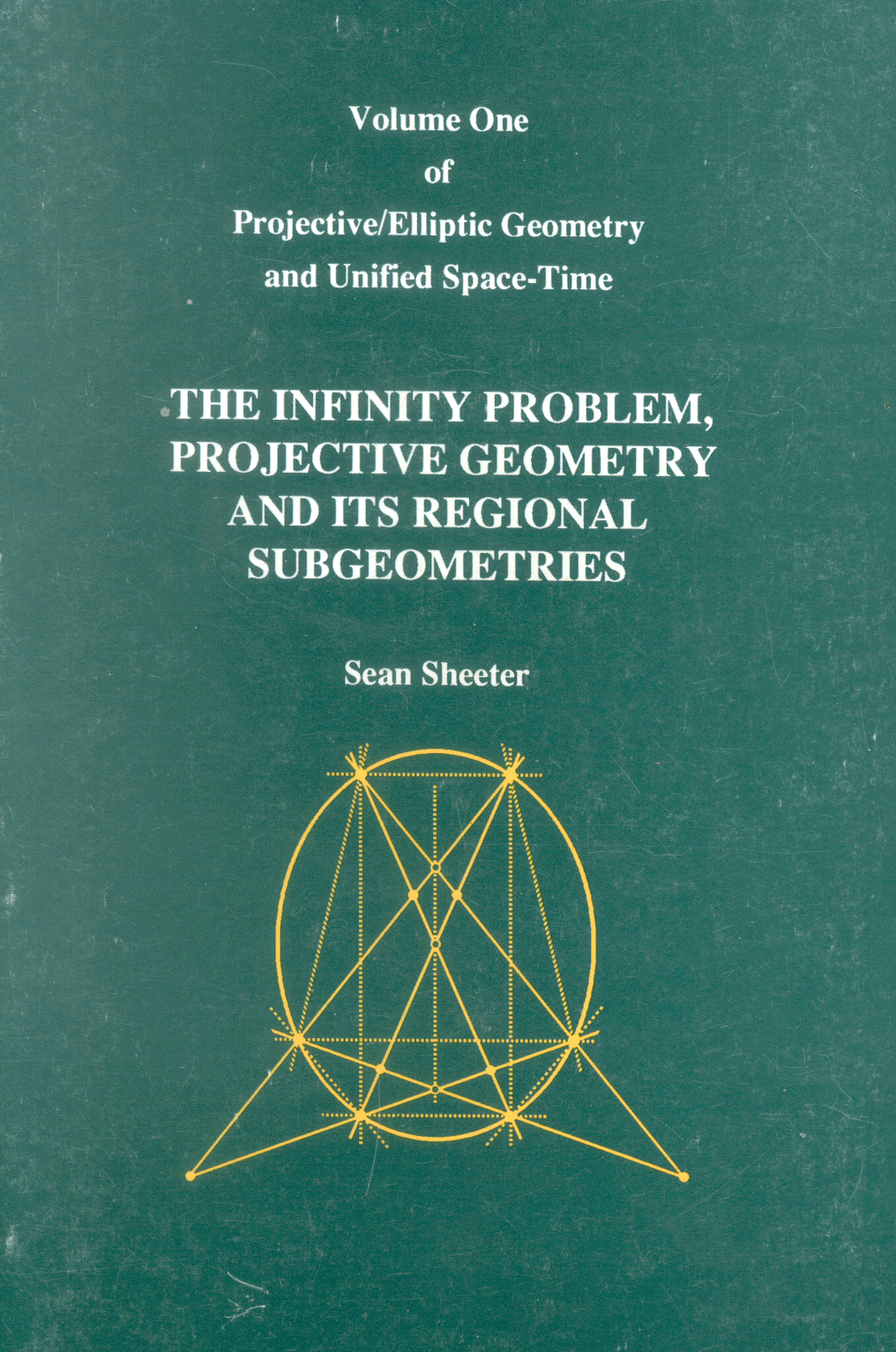
The Infinity Problem, Projective Geometry and its Regional Subgeometries
Sheeter’s supporting 290 page text, provides the categorically consistent and complete geometric basis for this 11-dimensional tautology. A distillation of Felix Klein, Veblen and Coxeter’s
works in one volume, it unites all subgeometries, so too all substages of (physical) existence, with a synthetic ‘formal simplicity’ emphasizing common projective tenets that fueled Klein’s old
'Erlangen program.'
Given the series title of this 1987 printing (process press, Berkeley) is Volume One of Projective/Elliptic Geometry and Unified Space-Time,
it should be evident that
241 Mumbers serves as, but far exceeds the original expectations for, the second volume of this series,
further justifying why the geometry book was withheld, remaining unpromoted
until this more opportune moment. (So, now a national mailing failed to produce one order from a math library; which figures!1cB-dE) Promotional
issues aside, this connection between geometry and physics is well established
with regard to the importance of the above cover figure in the 2009 article
The Origin of the 11D World Membrane as a Pascal Conic Section of a 6D String in a 5D Projective Space.
A chapter outline of the synthetic geometry
text is as follows. Chapter I:
A Historical Overview of the Infinity and
Parallelism Problems in Geometry.
Chapter II: An Overview of Projective Geometry in
a Minimal Categorically Complete Configurational System. Chapter
III: Propositions of Incidence and the
Construction of Configurations and Rational Systems. Chapter IV:
The Propositions Necessary For Rational, Real and Complex
Projective Spaces. Chapter V: The
Elliptic Metric in the Real Region of a Complex Projective Space.
Chapter VI: The Subgeometries in Convex Regions
of Real Projective Space - which covers a
generalized model of descriptive and
affine geometries relative to 'the
Absolute' that establishes the following metric subgeometries. The first of
which is Euclidean, where we borrow
heavily on Hilbert's text and Coxeter in regard to its specific symmetries. We then discuss
the projective foundations of Lobatschevski's
hyperbolic geometry, concluding with, what I believe is, an
unprecedented projective description for the affine
metric of Minkowski geometry - so serves as an
interface of geometric tenets necessary for a discussion of space-time physics.
Which warrants a few final comments on some 4D and 5D space-time models that
have been used to
generalize and/or unify metric curvatures,
such as that employed by Einstein once he'd mastered Riemann's
geometry (noting that his contemporary Clifford's ideas of
Chap. 5 on more general elliptic spaces relatively took years to be
appreciated). But that came before Einstein began hanging out with the likes of masters
Felix (or Oskar) Klein, P. G. Bergmann and
Gödel (so it may be fun to try to decipher Occam's and my sly critique of Al and
Kurt's views on space-time curvatures in
Rant 5) while working on unifying the fields,
and/or/as space-time theories, of special and general relativity.
241 Mumbers also offers both books as part of the e-interactive
program of advanced courses and an up-dated subscription service - check the order page for a few further details.
|